
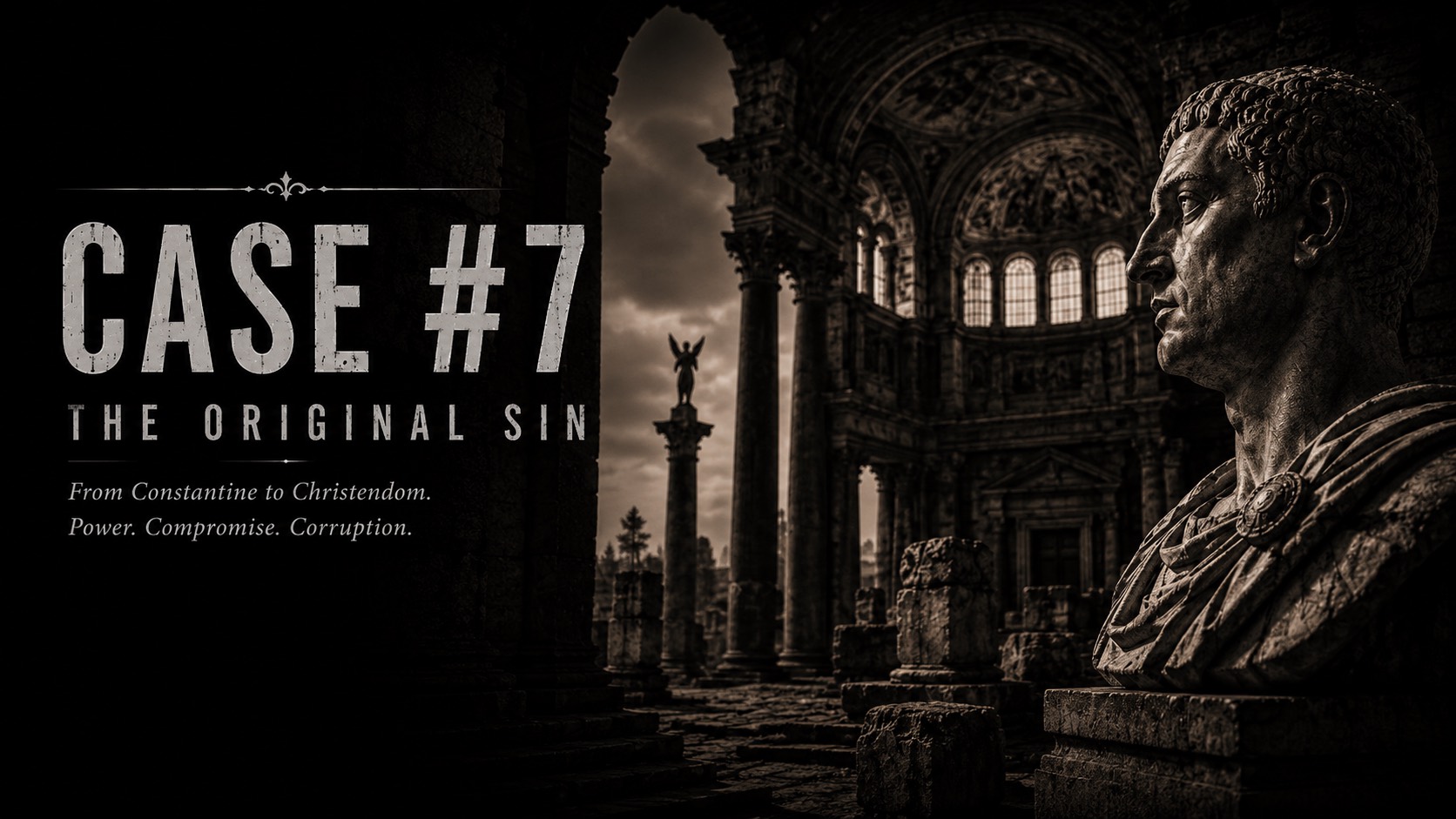
Filed: As Structural Evidence Supporting Cases #1 Through #6
Defendants: The Institution of Christianity as a Political and Social Power Structure
Members of the jury, you have now heard six cases. Six churches. Five betrayals. Named individuals, specific dates, documented harm.
Before you render a final verdict, this court must address the question that every honest juror will have been forming since Case #1:
Is this a pattern – or is it a coincidence?
The defence will argue coincidence. They will say that bad leaders exist in every institution, that the church is made up of flawed human beings, that what happened to Don Cormier reflects individual failures rather than systemic ones.
This case exists to answer that argument directly.
What you are about to hear is not opinion. It is history – documented, sourced, and older than any of the institutions named in Cases #1 through #5. It is the history of how Christianity was transformed from a persecuted movement of the powerless into the most effective institutional control structure the Western world has ever produced.
And it is the history of how that structure, once built, has operated with remarkable consistency for over 1700 years – protecting itself, silencing dissent, managing its reputation, and sacrificing the individual on the altar of institutional survival.
Every defendant in this trial inherited that structure. None of them built it from scratch. All of them used it.
To understand what Christianity became, the jury must first understand what it was.
In its first three centuries, Christianity was a minority movement operating under active persecution from the Roman Empire. It had no armies, no state backing, no legal standing. It spread through personal testimony, community, shared meals, and the radical claim that the powerful and the powerless were equal before God.
It was, by any measure, a movement built by and for the marginalized.
The earliest Christian communities were notable for what they lacked: hierarchy, property, political power. Leadership was communal. Orthodoxy was contested openly. Women held positions of authority. The poor were centered, not managed.
This is the Christianity that produced the Sermon on the Mount, the feeding of the five thousand, the washing of feet. A faith whose founder specifically warned, in Mark 10:42-45, against the exercise of authority as the Gentiles practiced it – top-down, coercive, self-serving.
"Whoever wants to become great among you must be your servant."
That Christianity lasted approximately three centuries before the empire got hold of it.
In 312 AD, the Roman Emperor Constantine claimed to have seen a vision before the Battle of Milvian Bridge – a Christian symbol, and the instruction: in this sign, conquer.
Whether the vision was genuine, strategic, or invented entirely is a question historians have debated for seventeen centuries. What is not debated is what followed.
Constantine legalized Christianity with the Edict of Milan in 313 AD. He returned confiscated property to the church, funded the construction of basilicas, and began the process of integrating Christian leadership into the machinery of the Roman state.
Within a generation, the faith of the persecuted had become the faith of the empire.
The jury should sit with what this transition actually meant. An institution that had survived by being outside power – that had drawn its moral authority precisely from its willingness to suffer rather than compromise – was suddenly inside power. Funded by it. Protected by it. Eventually synonymous with it.
Power does not transform institutions. Institutions transform to accommodate power. And Christianity, over the course of the fourth century, transformed completely.
The bishops who had once hidden from Roman soldiers now sat in Roman councils. The communities that had shared everything now accumulated property. The faith that had centered the poor now crowned emperors.
And the people who had once been protected by the church's outsider status – the vulnerable, the marginalized, the ones the earliest communities had been built around – were now protected only by the goodwill of leaders who had discovered that goodwill is expensive and power is cheap.
In 325 AD, Constantine convened the Council of Nicaea – the first empire-wide council of Christian bishops. Its stated purpose was to resolve theological disputes, primarily around the nature of Christ.
Its actual function was the standardization of orthodoxy as a tool of imperial unity.
Constantine was not a theologian. He was an emperor. He did not call Nicaea because he cared deeply about the precise relationship between the Father and the Son. He called it because a fragmented Christianity was a political liability, and a unified Christianity was a political asset.
What emerged from Nicaea was not just a creed. It was a mechanism. A defined orthodoxy creates, by definition, a defined heresy. And heresy – the act of believing wrongly – could now be identified, prosecuted, and punished by an institution with the full backing of the Roman state.
For the first time in Christian history, believing the wrong thing had legal consequences.
The jury should recognize what this represents: the transformation of faith from a personal and communal experience into a compliance system. You did not simply believe or not believe. You believed correctly, or you were a problem to be managed.
That mechanism – orthodoxy as compliance, dissent as heresy, questioning as threat – is the ancestor of every church discipline system, every removal without process, every whispered campaign against a worship leader who asked the wrong questions.
Father Camille Léger operated behind it. Marc Brulé and Andrew Thompson weaponized it. Pastor Mike Meinema used it. Carson Culp deferred to it.
They did not invent it. They inherited it. And it was 1700 years old when it arrived in their hands.
The decades following Nicaea demonstrated with brutal efficiency what a politicized orthodoxy produces.
Bishops who held minority theological positions were exiled. Communities that refused the Nicene formulation were labeled heretical and stripped of legal recognition. The process of theological debate – which had been the lifeblood of early Christianity – was replaced by the process of compliance and punishment.
The Arian controversy alone produced decades of exile, excommunication, and imperial intervention. Individuals who had spent their lives in faithful service to Christian communities were removed, silenced, and erased from institutional memory because they had answered the wrong question about the nature of Christ in the wrong way.
The jury should note the mechanism: removal without adequate process, based on the determination of those with institutional authority, with no meaningful avenue of appeal.
Sound familiar?
It should. Because the specific mechanism used against Don Cormier at Wellspring, at Southridge, at Rice Road, and at Christ Community Church is structurally identical to the mechanism codified at Nicaea and deployed across the Roman Empire in the fourth century.
The names change. The collars and the councils change. The mechanism does not.
By the thirteenth century, the church had developed the suppression of dissent into a formal institution: the Inquisition.
The stated purpose of the Inquisition was the identification and correction of heresy. Its actual function was the protection of institutional authority from challenge.
The jury should understand what the Inquisition actually was in practice, because it has been softened by centuries of historical distance. It was a system in which accusation functioned as evidence, in which the accused had no right to face their accuser, in which confession was extracted under torture, and in which the institution that defined the crime also conducted the trial and executed the sentence.
There was no due process. There was no presumption of innocence. There was no independent appeal.
Now the jury should compare that to what happened at Southridge Community Church in 2017, when a false accusation was made, acted upon without investigation, with no opportunity for the accused to face his accuser or present his account – and a private apology was offered in lieu of the public restoration that justice required.
The Inquisition did not end. It was scaled down, professionalized, and distributed across ten thousand evangelical churches.
The mechanism is the same. Accusation as evidence. Institution as judge. Individual as expendable.
Don Cormier is Acadian and Mi'kmaq.
That is not incidental to this trial. It is central to it.
The same institutional Christianity that built the Inquisition sent missionaries across the Atlantic with European colonizers in the fifteenth and sixteenth centuries. The same theological framework that defined heresy as a crime defined Indigenous spiritual practice as Satanic. The same institutional protection system that covered for Father Camille Léger covered for the priests and nuns who ran the residential school system across Canada for over a century.
The residential school system was not a misapplication of Christian values. It was a direct expression of the institutional logic this case has been documenting: the individual – in this case, the Indigenous child – is subordinate to the institution. The institution's goals – assimilation, cultural erasure, the expansion of Christian civilization – override the individual's dignity, safety, and survival.
The Truth and Reconciliation Commission of Canada documented over 150,000 children forcibly removed from their families. Over 4,000 confirmed deaths in the schools. Systemic physical, sexual, and psychological abuse conducted by people who wore the same collar as Father Camille Léger.
Don Cormier's Mi'kmaq ancestors survived that system. Don Cormier then encountered its direct descendant in Cap-Pelé, New Brunswick, in the form of a Catholic priest protected by the same institutional machinery that had protected the residential school system for generations.
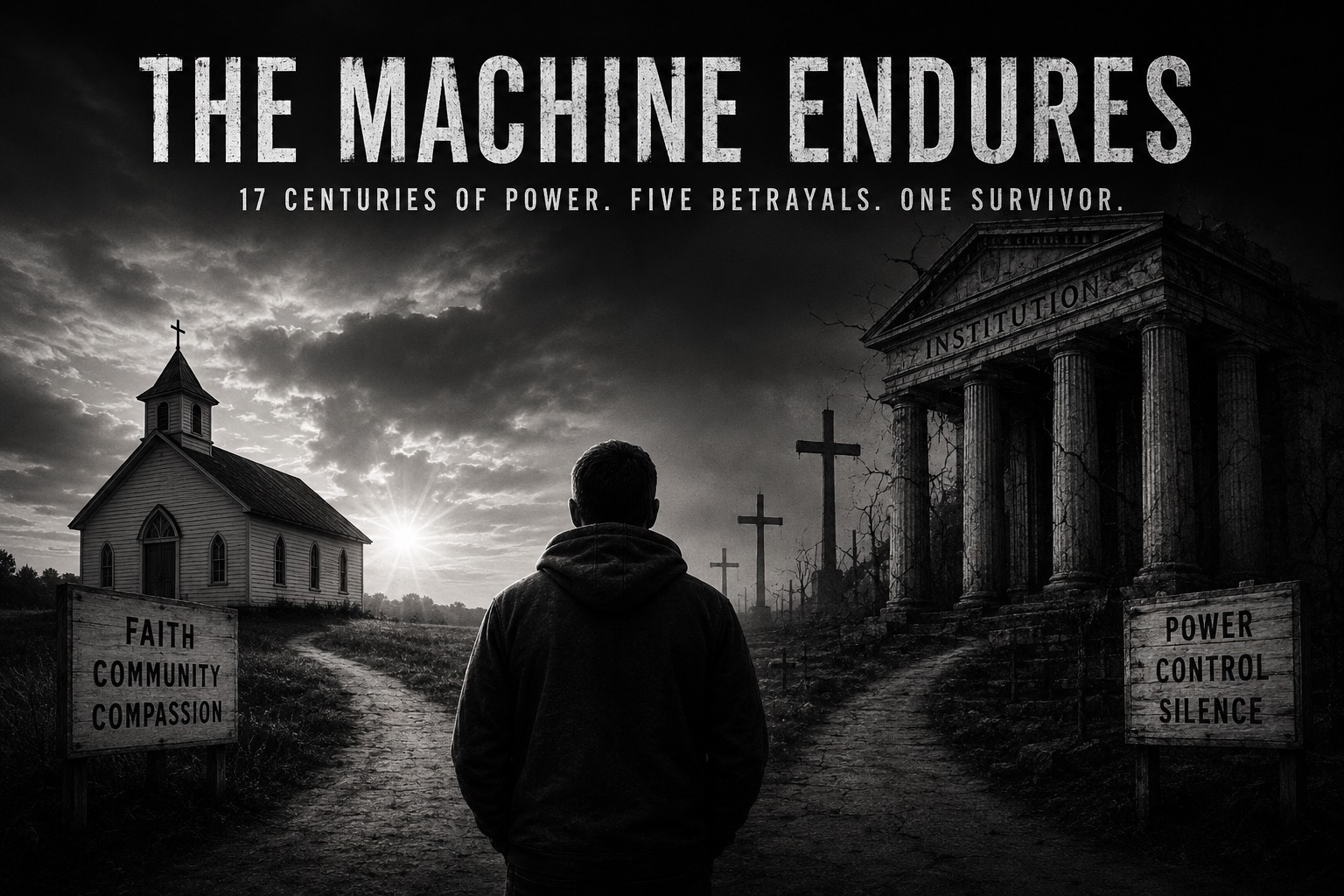
This is not a metaphor. This is a documented, unbroken institutional lineage from Constantine to Nicaea to the Inquisition to the residential schools to Sainte-Thérèse-d'Avila Parish.
The machine did not change. It just changed addresses.
The jury must understand one more tool in the institutional arsenal, because it is the one most directly responsible for keeping people inside systems that harm them long past the point where they should have left.
Fear theology is the use of eternal consequences as a mechanism of compliance.
The doctrine of hell – eternal conscious torment as the punishment for unbelief or disobedience – is not prominently featured in the earliest Christian writings. It was developed, elaborated, and weaponized over centuries as institutional Christianity discovered its extraordinary utility as a control mechanism.
If leaving the church means eternal damnation, the cost of leaving is infinite. If questioning leadership means spiritual rebellion, the cost of questioning is your soul. If failing to comply with institutional demands means separation from God, then institutional demands carry divine authority regardless of their actual content.
This is not theology. It is psychological leverage.
And it works. It kept people inside the Roman Catholic Church through the Inquisition. It kept Indigenous families from resisting the residential school system. It kept members of Wellspring Community Church from standing up when Don Cormier was removed without process. It kept Paul Glasbergen from helping a man he claimed to love at Southridge, because God, he said, was not leading his heart to do so.
Fear theology does not produce faith. It produces compliance. And compliance, unlike faith, does not require the institution to earn anything.
The jury may be tempted to conclude that what this case describes is ancient history – the sins of medieval popes and colonial missionaries, corrected by the Reformation, the Enlightenment, and the steady progress of moral understanding.
The evidence of this trial does not support that conclusion.
The modern evangelical church has retained, in updated form, every structural feature this case has documented:
The authority of the pastor is treated as spiritually derived and therefore resistant to challenge. The Matthew 18 process – which exists precisely to protect individuals from institutional power – is invoked when convenient and bypassed when inconvenient. Accusation functions as sufficient basis for action against individuals who lack institutional standing. Reputation management drives decisions that are presented as spiritual discernment. Dissent is labeled as offense, rebellion, or spiritual immaturity. People who leave are managed, not reconciled.
These are not the failures of bad individuals operating inside good systems. They are the predictable outputs of a system that was designed, from the fourth century onward, to protect itself.
Father Camille Léger was transferred, not removed – because the Diocese calculated that exposure was more dangerous than redeployment. Marc Brulé lied from the pulpit – because the truth was more dangerous to the institution than the lie. Pastor Mike Meinema refused a public apology – because public accountability was more dangerous to his standing than private settlement.
Constantine would have recognized every one of those decisions. He made the same kind every day.
Members of the jury, Don Cormier did not have the misfortune of encountering six bad churches in a row.
He had the misfortune of encountering the same church six times.
The institution that abused him as an eleven-year-old boy in Cap Pelé, New Brunswick, and the institutions that betrayed him across the Niagara region across three decades, are not separate phenomena connected only by his presence. They are local expressions of a single institutional logic that has operated continuously since the fourth century -- a logic that places institutional survival above individual dignity, that uses the language of God to do the work of power, and that has refined its mechanisms of self-protection across 1700 years of practice.
Don Cormier is Acadian and Mi'kmaq. His ancestors survived the expulsion of the Acadians and the colonial erasure of the Mi'kmaq people -- both of which were conducted under the banner of Christian civilization, with the full institutional backing of the church.
He then survived a predator priest protected by the same institutional machinery that protected the residential schools.
He then survived five iterations of the same evangelical protection system, in five different buildings, with five different sets of names on the doors.
And then -- when he had nowhere left to go -- he turned to a brotherhood of men he had served faithfully for ten years, men who had told him they loved him, men who had watched him pour himself out every Wednesday night for a decade. And discovered that the machine does not only run inside institutions. It runs inside the hearts of the people those institutions produce.
Not one of them showed up.
He survived all of it. He is still here. And he built this trial because the machine is still running -- in Cap Pelé and Welland and every city in between -- and someone had to say so out loud.
The personal cases -- #1 through #6 -- show you what the machine does to one man.
This case shows you where the machine came from, how it was built, and why it keeps producing the same results regardless of the century, the denomination, or the name above the door.
The jury now has everything it needs.
The Institution of Christianity as a Political Power Structure: Guilty of constructing and maintaining, across seventeen centuries, a system of authority that prioritizes institutional survival over individual dignity; that uses theological language to enforce compliance and suppress dissent; that has protected predators, enabled colonizers, traumatized children, and silenced survivors – not as aberrations, but as the predictable output of its own design.
The Roman Catholic Diocese of Moncton: Guilty as a contemporary expression of that system, operating its protection mechanisms against Don Cormier and 250 confirmed victims with the same institutional logic Constantine codified in the fourth century.
The Evangelical Church Network represented in Cases #2 through #5: Guilty of reproducing, in modern form, the same structural features – authority without accountability, accusation without process, reputation management over truth – that the institutional church has carried since Nicaea.
In 325 AD, the Council of Nicaea decided what Christians were required to believe.
In 2017, Southridge Community Church decided what Don Cormier was required to have done – without evidence, without process, without appeal.
The distance between those two events is 1700 years.
The distance between those two mechanisms is nothing at all.
This court has heard the evidence. The machine has been named. The record is complete.
What the jury does with it is the only question that remains.