
Before you weigh a single piece of evidence in this trial, you need to know who is standing before you.
Not as a victim. Not as a statistic. As a witness.
My name is Joseph Donald Cormier. I am a proud Acadian and Mi’kmaq – a descendant of the spirit of Nombretu, of the Mi’kmaq people. I was born in Toronto in the winter of 1961, the middle child in a family where love was distributed unevenly and I came up short.
My older brother was my father’s favourite. My younger sister was his little angel. I was the one in between – overlooked, unwanted, and in the way. That was my first lesson in how institutions work: some people are protected, and some are not. I learned it before I could read.
I want to be precise about something the defence will try to obscure: the church did not find me whole and break me. It found me already bleeding – and chose to cut deeper.
By the time I was eight years old, my father had shattered a pool cue over my head. By ten, he had slammed my head in a refrigerator door for the crime of looking for food. He strangled me into unconsciousness more than once. These were not isolated incidents. This was the climate of my childhood – unpredictable violence from a man who, according to my mother, hated me because I reminded him too much of himself.
PTSD did not begin with Father Camille Léger. It began in my own home, before I had a name for it, before I had words for any of it. I only knew fear, and I knew it the way other children know breakfast – as something that simply begins every day.
My parents separated eleven times. He left for months, sometimes nearly a year. When he returned, the cycle resumed. My mother was not cruel – she was desperate. She was a woman trying to hold a family together with no tools and no support, in a world that told her to stay, pray, and endure.
So she turned to the one institution that promised to help.
When our family relocated to Cap Pelé, New Brunswick – the town where my parents were born – my mother sought refuge in the local parish. Father Camille Léger of Sainte-Thérèse-d’Avila was waiting.
He was not merely a priest. In a small Acadian coastal village, he was the axis around which the entire community turned. Feared, revered, untouchable. He convinced my mother – a grieving, exhausted woman looking for any handhold – that I should join the Altar Boys and the Boy Scouts. Both programs were under his direct control.
She said yes. She believed she was handing me toward safety.
For more than two years, Father Camille Léger used those positions to abuse me – sexually, physically, and psychologically. I was eleven years old when it began.
I will not detail every act here. I don’t need to. What matters for this court is the pattern: a predator who identified a vulnerable child, cultivated the trust of a desperate parent, and operated behind the full protection of an institution that knew and said nothing. And they did know. That is not an allegation. That is a documented fact. Parents had already been quietly pulling their children from his programs years before my family arrived in Cap Pelé. The RCMP knew his reputation. Members of the congregation knew. Not one person warned my mother.
Their silence was not passive. It was a choice. And that choice had consequences measured in decades of my life.
By the time I was twelve, I had absorbed more violence than most people encounter in a lifetime – from my father at home, and from a priest in a position of sacred trust. There was no safe place. There was no person I could point to and say: that one will protect me. I decided to end my life.
I won’t describe how. It serves no purpose here. What matters is that I survived – not because life felt worth living, but because I failed. And in that moment, the voice in my head was not relief. It was contempt. What a loser. You can’t even do this right. That is what prolonged abuse does to a child’s inner voice. It installs the abuser’s contempt so deeply that the child begins to do the abuser’s work for them.
I turned to solvents and model glue to survive the days. Then street drugs. Then alcohol. The logic was simple: if I could not escape the pain, I could drown it. For a long time, that was the only plan I had.
Eventually, I told my mother I didn’t want to be an Altar Boy anymore. I couldn’t explain why – not yet. But the secret didn’t stay buried long.
A friend told her. My mother came to me, and I told her everything. I watched her grief turn to fury in real time. She was ready to kill a priest. Instead, she did something harder – she tried to get justice through legitimate means.
She went to the townspeople of Cap Pelé. She went to the RCMP. The answer, every time, was the same: You can’t go against the church. Catholic officers stationed locally advised her that pursuing charges would only cause embarrassment. She was told, in effect, that the reputation of an institution mattered more than what had been done to her son.
She fought as long as she could. Then she broke. Within months, she suffered a nervous breakdown and was hospitalized for a month. The church had not only destroyed something in me – it had destroyed something in her too.
Not long after, I went to a place called LeBauto – a fishing wharf where kids my age would dive off the pier in summer. I was climbing back up the ladder after a dive when I heard it:
“Here comes the little queer now!”
I looked up. A group of older men in the back of a pickup truck, drinking and laughing. A dozen other people nearby, staring. And in the middle of it – my father. Laughing along with them.
He looked slightly uncomfortable. But he laughed.
I rode home on my bicycle. By the time I arrived, the shame had finished converting itself into something else. From that day forward, I was constantly high and constantly angry – at everything, at everyone, at a world that had shown me repeatedly that I did not matter.
Not long after the wharf, my father and I collided in a final, catastrophic fight. His rage escalated until he had his hands around my throat. He strangled me until I lost consciousness.
My older brother pulled him off before he finished.
When I came to, I understood something with complete clarity: if I stayed, I would die in that house. I walked out the door at fourteen years old with the shirt on my back and did not go back.
My mother sent word through my friends: Don’t come home. Your father will kill you.
She was not being dramatic.
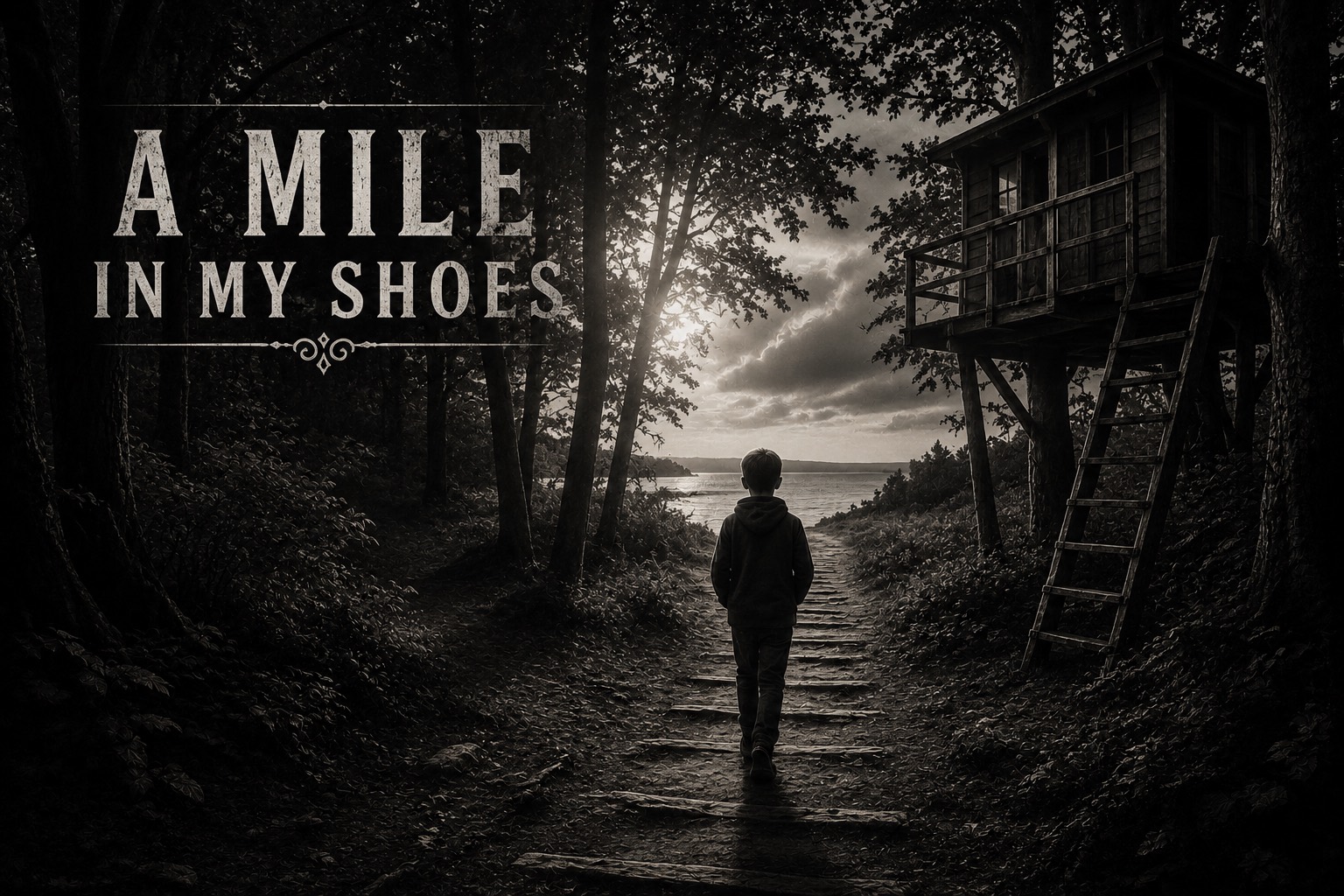
I found shelter in a treehouse my friends and I had built – high up, hidden, with a small fireplace. What had been a hideout became a home.
When I tell people I lived alone in the woods at fourteen, they expect me to describe it as desperate. It wasn’t. For the first time in my life, I felt safe. Away from my father, away from Léger, away from the machinery of adults who had failed me at every turn – I could finally breathe.
The police eventually became aware I was out there. My friends protected my location. Even some of their parents knew and said nothing. For once, silence worked in my favour.
Freedom, even this kind, had a cost. With no structure, no supervision, and no reason to believe the future held anything worth protecting, my life became reckless by design. If nothing mattered, nothing was off limits.
I will not romanticize what followed. The short version: seventeen jails. Thirteen drug rehabilitation centres. Four mental institutions. One straitjacket.
Most of that happened before November 8, 1990 – the day I got sober for the last time, celebrating my thirtieth birthday in the last rehabilitation centre I would ever attend.
Sobriety was not a cure. It was a beginning. The chaos stopped; the pain did not. I knew something was still profoundly wrong with me, but I had no framework to understand what. I walked every recovery road available – AA, NA, CA – and stayed clean, but felt like I was holding on with my fingernails.
Two years in, my first marriage ended. I still didn’t fully understand why I couldn’t hold things together. I only knew that I was trying, and trying wasn’t enough.
Searching for community and meaning, I turned back to the church. It was there I met Charlene, who would become my wife. I found a place in worship leadership, writing music, leading Sunday services. People connected with what I offered. For a time, it felt like something was finally working.
Then the same machinery that had ground me down in childhood revealed itself again – this time in the language of evangelical politics. Finger-pointing. Judgment. Betrayal dressed in scripture. Friends who told me I would burn in hell.
I tried other churches. The pattern repeated. And I began asking a question I could not un-ask:
If every trauma I have ever experienced came at the hands of people who claimed to follow Christ – is that a coincidence?
I no longer believe it is.
For two years I lived under the weight of daily flashbacks and persistent suicidal thoughts. I had made a promise to Charlene that I would seek help. That promise is the reason I am alive.
I reached out to Niagara Regional Mental Health. They connected me with a program called Hope Recovered – a group built around understanding PTSD, its symptoms, and its triggers. From there, I worked with a therapist specializing in trauma recovery. For more than a year, ninety minutes a week, we went through my life systematically – starting at the beginning, giving each wound the attention it had never received.
The hardest part was not revisiting the abuse. It was confronting the fact that every person who had harmed me most deeply had professed faith in Jesus Christ. That was not incidental to my story. It was central to it.
I am not the boy at the wharf anymore. I am not the fourteen-year-old in the woods, the man in the straitjacket, the worship leader waiting for the next accusation.
I run a technology business now in its twenty-third year, serving over a thousand businesses across the Niagara region. I am making music again – my first album, built with my childhood friends Louis, Eric, and James. Charlene and I are doing the work of rebuilding something real.
Healing from PTSD does not mean forgetting. When the story of Father Camille Léger broke publicly – 250 confirmed victims, headlines calling him a monster – it opened every wound I thought I had closed. It was messy and painful in ways I had not anticipated. But today is different.
I am Joseph Donald Cormier. I am Acadian and Mi’kmaq, a descendant of a people who survived everything that was thrown at them. I have not always had the luxury of choosing my battles. I have survived every one.
I did not build this trial for revenge. I built it because truth demands a witness. And because if my testimony spares even one person from the path I walked – then silence would make me complicit.
I cannot allow that.
The court may now proceed to the evidence.
– Don Cormier