
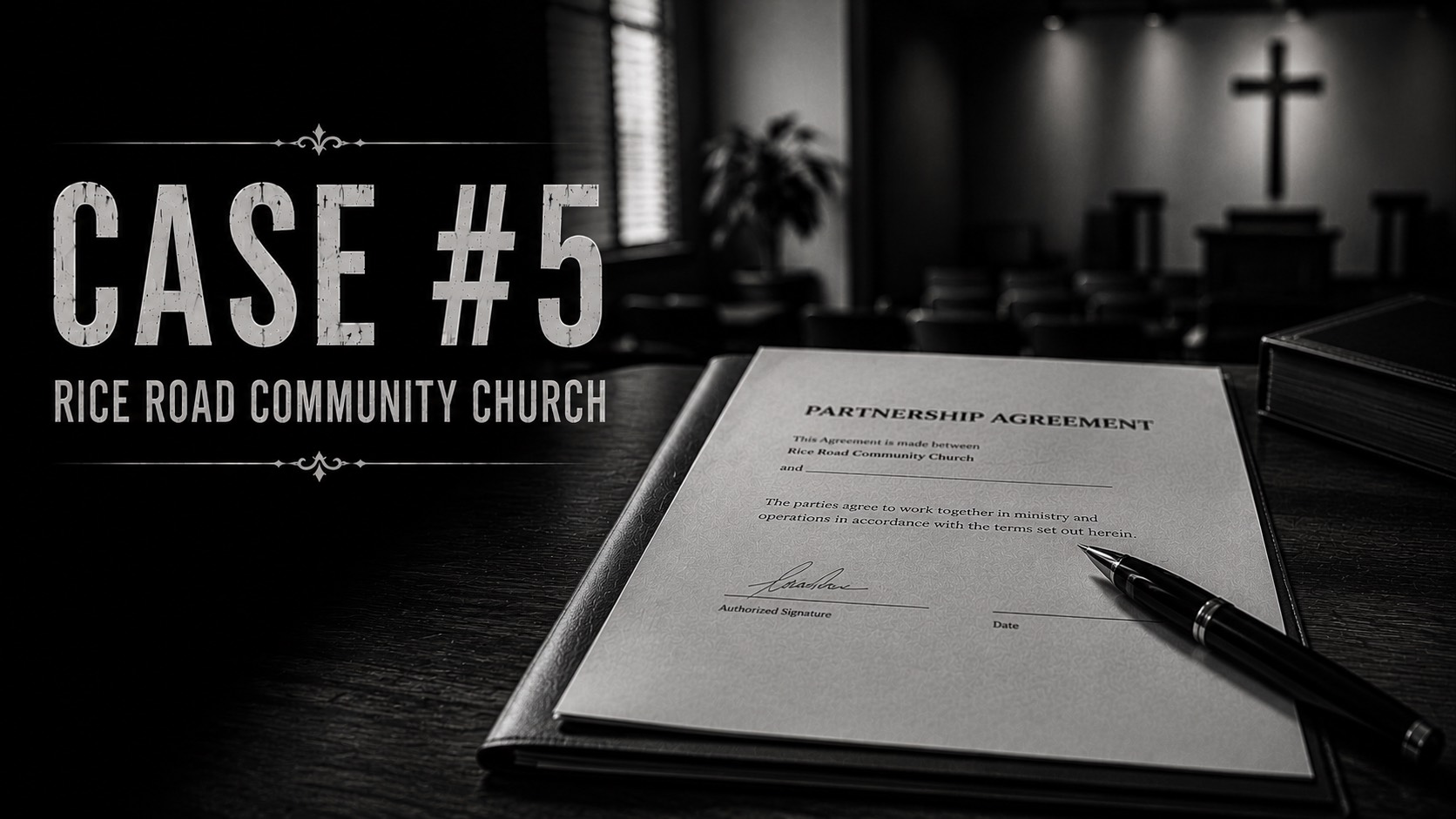
Filed: November 10, 2010 – Entered as Subsequent Evidence, 2024
Defendants: Pastor Bob Snyder | Pastor Matt Wiley | Rice Road Community Church
The jury is entitled to an explanation.
This case was not part of the original filing. It was added during the preparation of this trial – approximately one year ago – when the process of writing and reconstructing this account caused a memory to surface that had been submerged for years.
That is not a contradiction. That is CPTSD.
Complex post-traumatic stress disorder, particularly when it originates in childhood and compounds across decades, does not produce a clean linear narrative. The brain under chronic traumatic stress does not file memories the way a healthy nervous system does. It buries what it cannot process. It surfaces fragments when it is ready – sometimes years later, sometimes triggered by the act of bearing witness to other parts of the same story.
It was only in the writing of this trial that I fully connected what Rice Road Community Church did, and how directly it contributed to the circumstances that eventually led me back to Southridge – where the final and most devastating betrayal was waiting.
The defence may argue that a recovered memory is a convenient one. The jury should consider the alternative: that a man with CPTSD, reconstructing decades of institutional harm, would fabricate an entire chapter involving named individuals, a signed contract, and a documented financial loss.
That is not what happened here. What happened here is that the truth took time to surface. It has surfaced now. And it belongs in this record.
Members of the jury, every case in this trial has involved a betrayal. What makes Rice Road Community Church distinct is not the scale of what was done – it is the speed.
I arrived at Rice Road in 2009 carrying wounds from fourteen years at Wellspring. I was not naive. I was not looking for perfection. I was looking for one thing: a community that would do what it said it would do.
Rice Road could not manage even that.
Within a year, this church had pressured me while ignoring my clearly stated limits, allied its new leadership with the very men who had already destroyed my ministry once, lied to its own congregation, and breached a legally binding contract with my business – a contract they had signed in good faith and abandoned the moment it became politically inconvenient.
This case is not about a dramatic single betrayal. It is about a church that failed every basic test of integrity it encountered, in rapid succession, and apparently felt no obligation to do otherwise.
It also explains something the jury would otherwise be missing: why, after everything that had already happened, I ended up back at Southridge. Rice Road was supposed to be the bridge to something better. Instead it became another closed door – and Southridge was the only one still open.
That context matters. Because what happened at Southridge the second time did not occur in a vacuum. It occurred at the end of a road that Rice Road helped build.
I did not find Rice Road on my own. I was brought there by Mark Garner – a friend who had also been caught in the fallout from Marc Brulé and Andrew Thompson at Wellspring. Mark had already connected with Senior Pastor Bob Snyder and thought Rice Road might offer both of us a genuine fresh start.
I want the jury to understand what it took for me to walk through those doors. I had spent fourteen years at Wellspring investing, building, leading – and had been false-accused, publicly undermined, lied about to other pastors, and watched a man I had considered a colleague follow me from church to church to close doors behind me.
I was not a man who trusted easily anymore. I went to Rice Road because a friend I trusted said it might be different.
Mark Garner was wrong. But he was not lying. He believed it too.
Within two weeks of my arrival, Pastor Bob Snyder called me into his office.
I assumed it was a pastoral check-in – a chance to understand where my wife and I were coming from, what we had been through, what we needed. Instead, he asked me to lead worship.
I said no. I was clear about why: I was still raw from Wellspring. The wounds were recent. I was not in a position to take on worship leadership, and I knew myself well enough to know that pushing into that role before I was ready would not serve me or the congregation.
I offered what I could – to sing, to play guitar, to contribute without leading. That was my boundary. I stated it plainly.
Pastor Bob accepted it in the moment. But the fact that he asked – two weeks in, without yet knowing my history, without any pastoral groundwork – was the first indication that my needs were not the priority in that room. His church's needs were.
A pastor who asks a visibly wounded person to take on leadership responsibility two weeks after their arrival is not reading his congregation. He is managing his resourcing problem.
Pastor Bob asked me to design a website for Rice Road Community Church. As a technology professional with over two decades of experience, I agreed – and I gave them a significant discount as a gesture of goodwill toward a community I was trying to invest in.
We signed a five-year contract. Sixty dollars a month. The agreement covered design, hosting, training, and ongoing support. It was a legally binding document, signed by both parties, representing a professional commitment on my part and a financial commitment on theirs.
Bob Snyder handled the arrangement respectfully. I want to acknowledge that. The contract itself was not the problem.
What happened to it was.
Pastor Bob Snyder was removed from his position. The jury should note that his removal was handled dishonestly – but I will address that in the next exhibit. What matters here is what happened immediately after Matt Wiley became senior pastor.
In his first week – his first week – Matt Wiley met with Marc Brulé.
The jury will recall from Case #2 that Marc Brulé was the pastor whose false accusation, lack of process, and public lie from the pulpit had driven both Mark Garner and me out of Wellspring Community Church. He was not a neutral figure. He was not a respected regional leader with no connection to my situation. He was one of the specific people whose conduct this trial is prosecuting.
By the end of that first meeting, Matt Wiley, Marc Brulé, and Andrew Thompson were allies.
Matt Wiley then came to tell me about it. He was excited. He appeared genuinely unaware of how deeply what he was describing cut – that the first significant relationship his new leadership had formed was with the men who had already destroyed my ministry once.
I want to give Matt Wiley the benefit of the doubt on ignorance. What I cannot give him is the benefit of the doubt on what came next – because once he knew, he proceeded anyway.
Mark Garner was the one who caught it first.
Church leadership had been lying to the congregation about the circumstances of Pastor Bob Snyder's removal. The details of what was said and what was true are less important than the fact of it: people in positions of spiritual authority, entrusted with the honesty that pastoral leadership requires, looked their congregation in the face and told them something that was not true.
Mark Garner confronted leadership directly. He left immediately when it became clear no honest accounting would be offered.
My wife and I left a week later. Within weeks, others followed. What had been a community became an exodus – not of difficult people, not of troublemakers, but of people who had applied a simple standard: does what you say match what you do? And had received a clear answer.
It did not.
After my wife and I left Rice Road, my five-year contract with the church was still active. It had time remaining. It represented a legal obligation that Rice Road had entered into voluntarily.
Pastor Matt Wiley canceled it unilaterally. His stated reason: a youth in the congregation would build a new website instead.
There was no dispute about the quality of my work. There was no clause in the contract that permitted cancellation under these circumstances. There was no offer of compensation for the remaining term.
The breach cost my company thousands of dollars. This was not a symbolic loss – it was a direct financial injury to a business I had built over two decades, inflicted by a church that had just allied itself with the men who had already taken years of my ministry.
I want the jury to sit with the full picture: I had tithed to Rice Road during my time there. I had given money to this congregation in an act of faith and participation. That money went to support a leadership that would not honor a signed contract with the same man who had given it.
That is not a footnote. That is the character of the institution on full display.
"This case was added late. That undermines its credibility."
The timing of a memory's surfacing does not determine its truth. CPTSD is a documented medical condition with well-established effects on memory encoding and retrieval. Trauma does not always present itself in a neat, chronological sequence. The named individuals, the signed contract, and the documented financial loss are all verifiable. None of that was invented. All of it was buried – and all of it has now been found.
"Pastor Bob's request for worship leadership was a reasonable ask given Don's obvious gifts."
A reasonable ask requires reasonable timing and reasonable context. Two weeks. No pastoral history. No knowledge of what I had just come through. Asking a wounded person to lead before you have taken the time to understand the wound is not recognizing someone's gifts. It is exploiting their availability. The boundary I set was clear. The fact that it was set at all should have told Bob Snyder everything he needed to know about where I was.
"Matt Wiley's meeting with Marc Brulé was a normal part of building regional pastoral relationships."
In his first week. With the specific person whose conduct had driven away two members of his own new congregation. If Matt Wiley did not know the connection when the meeting was arranged, he knew it afterward. The alliance that followed – and the events it produced – cannot be separated from that foundational choice.
"The contract cancellation was a business decision and should be treated as such."
Correct. It was a business decision. And business decisions have legal and ethical consequences regardless of the context in which they are made. A church is not exempt from contract law. A pastor's collar does not void a signed agreement. Rice Road Community Church breached a legal contract and caused quantifiable financial harm. The fact that it occurred inside a religious institution makes it no less a breach and no less a harm.
Members of the jury, Rice Road Community Church lasted less than two years in my life. In that time it managed to pressure me past a clearly stated boundary, align its new leadership with proven manipulators, lie to its congregation about a pastor's removal, and breach a legally binding contract with my business.
Each of those failures would be significant on its own. Together they form a portrait of an institution that had no functioning commitment to integrity – not in its pastoral relationships, not in its treatment of its congregation, and not in its basic legal obligations.
But the most important thing this case establishes is the bridge it built. When Rice Road collapsed, I had nowhere left to go except back to Southridge. I went back not because I had forgotten what Southridge was, but because every other door had been closed – some by my own hand when I left, and some by the Thompson and Brulé network that kept following me.
Rice Road did not just betray me. It funneled me back into the path of the final betrayal.
That is its place in this trial. And that is why it belongs here.
Pastor Bob Snyder: Guilty of pressuring a visibly wounded person into ministry leadership within two weeks of arrival, without pastoral groundwork, in disregard of a clearly stated boundary.
Pastor Matt Wiley: Guilty of forming an immediate alliance with individuals whose conduct had already driven members of his congregation out of their previous church; of presiding over dishonest communication to his congregation about his predecessor's removal; and of unilaterally breaching a legally binding contract without cause or compensation.
Rice Road Community Church: Guilty of failing every basic test of integrity it encountered – pastoral, relational, congregational, and contractual – and of serving, whether intentionally or not, as the final mechanism that returned a wounded man to the place where the last and most devastating betrayal was waiting.
Rice Road did not break me. By 2009 I was already too familiar with this pattern for any single iteration of it to land as a surprise.
But that familiarity is itself an indictment. No person should become so accustomed to institutional betrayal by the church that a new one barely registers.
That is what years of this does. It doesn't just harm you once. It recalibrates what you expect from people who claim to follow Christ – until the bar is so low that basic honesty would feel like a miracle.
Rice Road couldn't clear even that.
And when it fell, it left only one door open.
The jury already knows what was behind it.
This court has noted it.