
Filed: 2010 – 2020
Defendants: The Men of Redeemed Lives | Rick Mills | The Unaccredited Denomination Behind the Network
Members of the jury, every case in this trial has involved an institution.
A diocese. A congregation. A pastoral hierarchy. A denomination. Structures with names on doors, bylaws in filing cabinets, and leaders with titles – however unearned those titles may have been.
This case is different.
This case is about men. Not institutions. Not pastors. Not hierarchies. Men who sat across a fire from me, who shook my hand, who looked me in the eye and told me they loved me. Men I drove hours to serve. Men I spent entire Wednesdays preparing for. Men I stayed late for while they went home to their couches, so that I could give them my full attention before I gave my gear its proper attention on the way out the door.
Men who, when I needed them to speak one sentence on my behalf, said nothing.
This case does not have a villain in a collar. It has something harder to prosecute and harder to forgive: ordinary men who knew what they ought to do, chose not to do it, and then called that choice the will of God.
The Bible they studied every Wednesday night is unambiguous on this point. James 4:17.
If anyone knows the good they ought to do and does not do it, it is sin.
This court is holding them to that standard. It is the only one they claimed to live by.
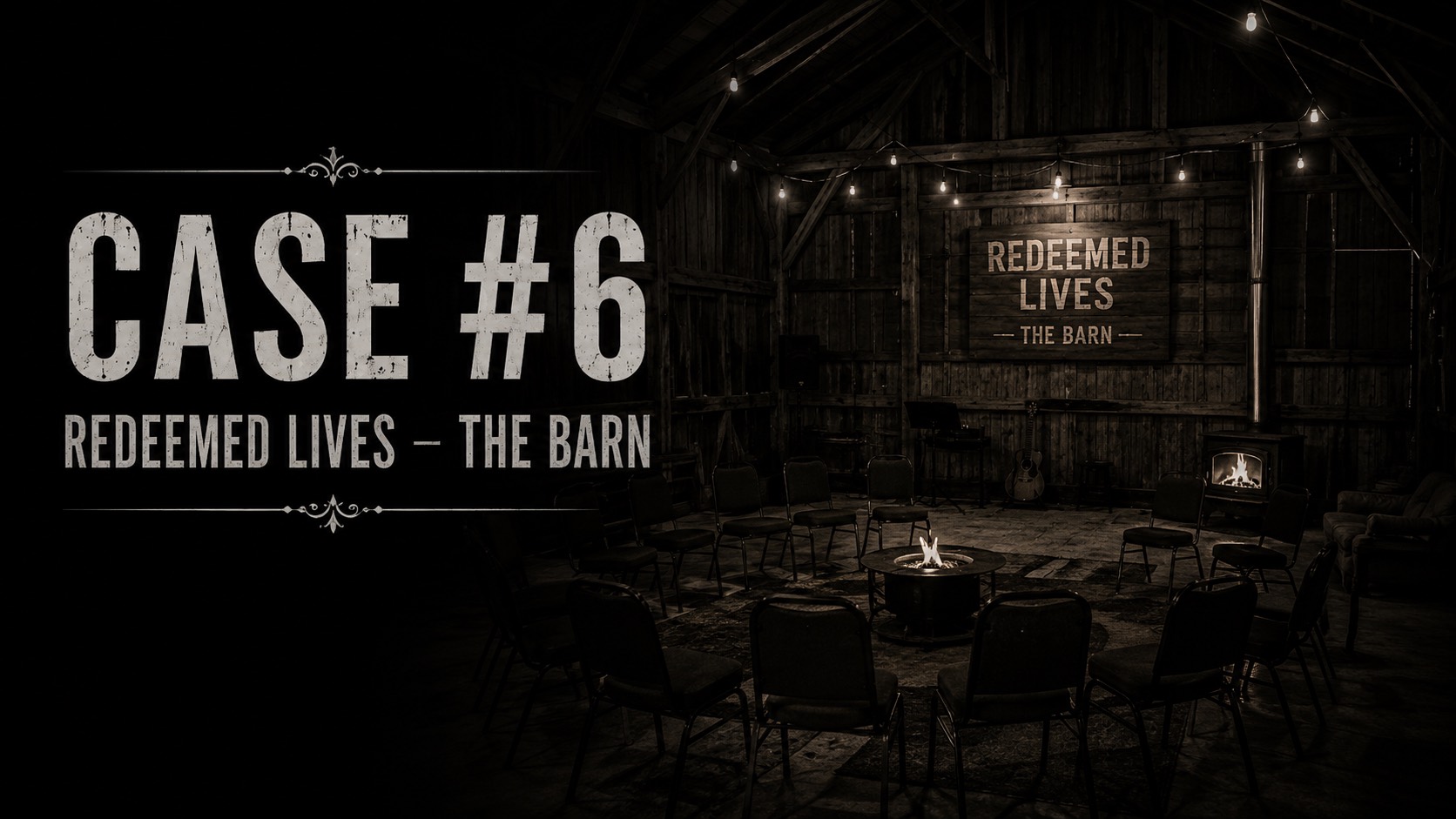
In 2010, I became co-leader of Redeemed Lives – a men's ministry in Welland, Ontario, known locally as The Barn. The name came from the venue: a renovated barn, nicely appointed, with a wood stove, a fireplace, a sound system, and the kind of atmosphere that makes men who don't usually open up begin to do so.
My co-leader was Todd Dixon. The ministry ran every Wednesday night, seven until nine.
What the jury needs to understand is what Wednesday actually looked like for me – because it was not two hours. It was an entire day.
I prepared the handouts. Printed each one individually. Folded them by hand. I prepared the music for the worship service, formatted the music sheets to the specific preferences of each musician coming in. When there was no speaker, I prepared the message as well. I loaded all of my gear into my car, drove it to the barn, unloaded it, set it up, led the worship, led or supported the ministry, and then – while everyone else was home by 9:30 relaxing – I stayed.
I did not pack my gear while the men were still there because I would not shortchange them on my way out the door. I waited until everyone had gone. Then I packed my gear properly, loaded the car, drove home, and carried everything back inside.
Every Wednesday. For ten years.
I also mentored individually. I drove out of my way – miles, hours – to serve and minister to specific men in that community. I dedicated myself not just to the Wednesday nights but to the lives those nights were supposed to support.
I am not recounting this to claim a debt. I am recounting it because the jury needs to understand the scale of what was freely given, in order to understand the scale of what was withheld when I needed something in return.
Throughout my ten years at Redeemed Lives, I was regularly commended for my work. The co-leaders looked to me for wisdom and direction. The men told me they loved me. They told me they appreciated me. They told me that what I did mattered and that I mattered to them.
I believed them.
I want to be precise about that: I believed them not because I was naive, but because the evidence at the time supported the belief. Men who have been through what I had been through do not extend trust casually.
I had earned the right to be suspicious of everyone who claimed to care about me. And I chose, after watching these men over years, to believe that what they said was real.
That belief is part of what makes this case worth prosecuting. I was not a newcomer who misread a superficial community. I was a ten-year veteran of that community who discovered, at the moment of maximum need, that a decade of declared love had a limit I had not been told about.
After what happened at Southridge in 2017, I continued at Redeemed Lives. I had nowhere else to go. The barn was the one community still standing.
I was not well. The men could see it. People began commenting that I was losing weight, looking gaunt. I was not hiding what was happening – I told many of them directly what I was going through.
I was on a waiting list for Niagara Regional Mental Health. I was suicidal. I was hanging on by the thinnest possible thread, waiting for help that would not arrive until 2021.
The men of Redeemed Lives knew this. Not in the vague way that people sometimes sense something is wrong. They knew it because I told them. I was explicit. I was a man in documented crisis, inside a community that had declared itself a brotherhood, asking that brotherhood to do what brothers do.
What I asked for was not extraordinary. I asked them to speak up. To say, in whatever context was available to them, that what had been done to me was wrong. That they knew me. That they had watched me serve for a decade and that the man being accused at Southridge was not the man they knew.
One sentence. From men who had given me ten years of them.
The silence was complete.
Jesus said in John 15:13: Greater love has no one than this – to lay down one's life for one's friends.
I am not asking anyone to lay down their life. I had laid down years of mine for these men and I was asking them to open their mouths once.
They could not manage it.
I have named Paul Glasbergen before in this trial, in Case #5. He appears again here because his failure at Redeemed Lives preceded and compounded his failure at Southridge.
Paul Glasbergen was one of the men who told me he loved me. He was one of the men who knew what I was going through. He was one of the men I went to specifically – not as a stranger requesting a favour, but as a friend of years requesting what friendship is supposed to mean.
His answer, here as at Southridge, was a variation of the same theme: God was not leading his heart in that direction.
The jury should sit with the theology of that response. A man who has declared love for another man, who watches that man in crisis, who is asked to speak a single sentence in his defence – and who declines on the grounds that God has not specifically instructed him to help.
This is what fear theology produces in practice. It does not produce cowardice that knows itself as cowardice. It produces cowardice dressed as discernment – inaction sanctified by the claim that God approved of it.
James 4:17 does not include an exemption for cases where God has not specifically prompted you. It says if you know what you ought to do and don't do it, it is sin.
Paul Glasbergen knew what he ought to do. He had told me he loved me. That declaration alone was sufficient instruction.
He did not do it. And he called that choice God's leading.
This court calls it what it is.
Rick Mills was a member of Redeemed Lives. He was also the former chairperson of the denomination to which Wellspring Community Church belongs -- the denomination of Marc Brule and Andrew Thompson. It is believed that Rick Mills nominated Marc Brule to succeed him as chairperson of that denomination.
The jury should hold that connection clearly: a man inside my closest remaining community was directly connected to the institutional network that had been following me and closing doors behind me for over a decade.
One day, Rick Mills and I encountered each other while out on our motorcycles. We stopped for coffee. He began asking questions -- which church did I attend, how did I know Andrew Thompson, why was I no longer in a church community.
I answered honestly. I told him the truth.
He shut me down immediately. He told me what I was doing was wrong. He did not ask clarifying questions. He did not extend the basic courtesy of hearing a full account before rendering judgment. He simply determined, within minutes, that a man who was speaking truthfully about harm done to him was the problem -- not the harm, not the people who caused it, but the act of naming it.
I watched a man who had presented himself as a brother reveal himself as a political actor protecting a network he belonged to. He did not care why I had left the church. He cared that I was talking about it in a way that reflected badly on people he was connected to.
The moment you speak truth about leadership failure in the evangelical world, you become the threat. Not the failure. Not the harm. You. The one telling the truth about it.
Rick Mills made that clear over coffee on a day when I was already barely surviving. And then he went back to his motorcycle and rode away.
The jury is entitled to understand the institutional structure that produced Marc Brule, Andrew Thompson, Rick Mills, and the network that followed me across fifteen years of ministry.
The denomination to which Wellspring Community Church belongs does not require seminary training. It does not require formal theological education. It does not require accreditation from any recognized academic or ecclesiastical body. Its pastors are, in the most precise sense of the term, self-proclaimed -- men who have decided they are called to lead, within a structure that has decided to take their word for it.
This is not a peripheral detail. It is the structural precondition for everything this trial has documented.
When a pastor has no external accountability -- no denomination with enforceable standards, no seminary that can revoke credentials, no licensing body that can strip a qualification -- the only check on his behaviour is the goodwill of the people around him. And as this trial has demonstrated repeatedly, goodwill inside these networks flows upward, toward the leaders, not downward toward the people those leaders harm.
A self-proclaimed pastor who surrounds himself with self-proclaimed allies, inside a denomination that has decided accountability is optional, is not a shepherd. He is a man with a title and no one authorized to take it away.
Marc Brule held that title. Andrew Thompson held it. Rick Mills held an even higher one -- the chairpersonship of the entire denominational structure -- and used it to install the man whose conduct is documented across three cases in this trial.
This is not a coincidence of bad character. It is the predictable output of a system designed without adequate safeguards -- a system that, by its own theological convictions, has decided that the Holy Spirit is sufficient accountability for any man who claims to be led by it.
The evidence of this trial suggests otherwise.
"The men of Redeemed Lives were not responsible for what happened at Southridge. They had no standing to intervene."
Standing is established by relationship, not by institutional position. These men had declared love, expressed appreciation, and accepted years of faithful service. That history creates a relational obligation that does not require institutional standing to honour. What I asked of them was not an intervention in church politics. It was the basic act of bearing witness to what they knew about the man they claimed to love. That requires no title, no standing, and no permission from leadership. It requires only the willingness to tell the truth about what you know.
"Rick Mills was entitled to his opinion about how Don was handling the situation."
Rick Mills was entitled to his opinion. He was not entitled to use a conversation initiated under the pretense of friendship to shut down a man in crisis and protect a network he was politically invested in. The issue is not his opinion. It is the use of a pastoral relationship as cover for political maneuvering -- the same mechanism this trial has documented in every case that preceded this one.
"The denomination's approach to pastoral credentials is a theological conviction, not a structural failure."
Theological convictions have consequences. A conviction that the Holy Spirit's guidance is sufficient accountability for pastoral leadership, without any external verification or enforceable standard, produces pastoral leaders who cannot be held accountable by any mechanism other than their own conscience. The evidence of this trial demonstrates what happens when that conscience is insufficient. The theological conviction does not excuse the structural failure. It explains it.
Members of the jury, I served Redeemed Lives for ten years. Every Wednesday. Every handout folded by hand. Every musician's sheet prepared in the format they preferred. Every night stayed late so that the men could leave first and I could give my gear the attention it deserved without shortchanging anyone on the way out.
I did not do that for recognition. I did not do it to accumulate a debt that could be called in later. I did it because I believed in what we were building -- a community of men who were honest about their brokenness and committed to each other through it.
When I was at my most broken -- suicidal, waiting years for mental health intervention, barely surviving the aftermath of what Southridge had done -- I discovered that the community I had believed in had a limit I had not been told about.
The limit was this: they would love me as long as loving me cost them nothing.
The moment it cost them something -- a conversation, a moment of social discomfort, the mild risk of disagreeing with a pastor or a denominational chairman -- the love evaporated. The appreciation evaporated. The declarations of brotherhood evaporated.
What remained was silence. And Rick Mills drinking his coffee across from a man whose truth he had just decided was inconvenient.
I am not asking the jury to condemn these men as evil. Most of them are not evil. They are ordinary -- ordinary in the specific way that institutions produce ordinary people: people who have been taught, by years inside a system that rewards compliance and punishes dissent, to protect the structure above the individual.
They learned that lesson well. And I paid for their education.
The Bible they read together every Wednesday night says this, in Proverbs 17:17:
A friend loves at all times, and a brother is born for a time of adversity.
I was in adversity. I had brothers. And not one of them showed up.
This court has noted it.
The Men of Redeemed Lives: Guilty of declaring love and brotherhood across a decade of faithful service, and of failing to honour those declarations at the single moment they were tested -- when a man they knew, who had given them everything he had, asked them to speak one sentence on his behalf and received silence.
Paul Glasbergen: Guilty specifically of invoking divine guidance as justification for inaction toward a man he had declared he loved -- a theological sleight of hand that this court recognizes as the use of God's name to avoid personal accountability.
Rick Mills: Guilty of using a personal encounter under the guise of friendship to politically protect a denominational network he had helped build -- and of compounding the harm of a man already in crisis by shutting down his truth rather than hearing it.
The Unaccredited Denomination: Guilty of constructing a pastoral credentialing system so devoid of external accountability that it produced, and then protected, the network of leaders whose conduct runs through Cases #2 through #7 of this trial -- and of dressing that absence of accountability in the language of Spirit-led conviction.
I stayed at the Barn until the pandemic closed it. By the time they reopened in 2022 and called asking me to come back, I had spent a year in prolonged exposure therapy -- ninety minutes every week, reliving every trauma, every betrayal, every Wednesday night, every folded handout, every man who said he loved me and meant it only until it cost him something.
I did not go back.
Not because I am bitter. But because the prolonged exposure therapy did what it was designed to do: it showed me, clearly and without the fog of hope, exactly what had happened and exactly what those relationships had been worth.
Some things you cannot unsee once you have seen them properly.
The men of Redeemed Lives were not my brothers. They were my audience.
I deserved brothers. I gave them everything I had and I deserved what I gave.
This court has heard it. The record is complete.