
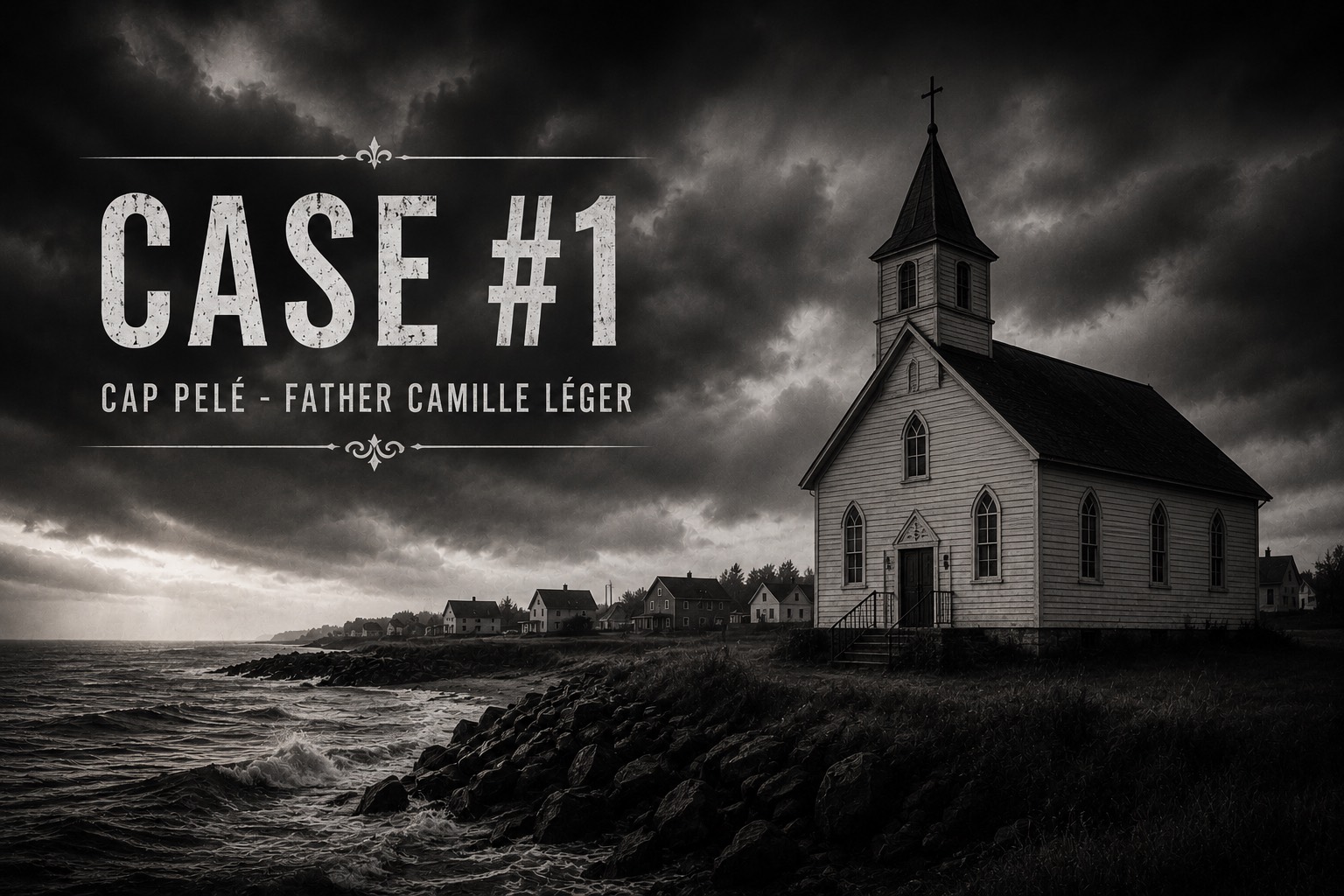
Filed: August 12, 1977 Defendants: Father Camille Léger | The Roman Catholic Diocese | The RCMP | The Parishioners of Sainte-Thérèse-d'Avila Parish
Members of the jury, this case begins in a small coastal village in New Brunswick – a place where the sea is close, the community is tight, and the church is everything.
Cap Pelé is the kind of place where everyone knows everyone. Where doors are left unlocked and children are considered safe because the adults are watching. Where the priest is not merely a religious figure but the axis around which the entire social order turns – more trusted than the doctor, more feared than the law, more permanent than any elected official.
It is precisely that kind of place where a predator thrives.
Father Camille Léger of Sainte-Thérèse-d'Avila Parish was not a monster who operated in darkness. He operated in plain sight – in the sanctuary, at the altar, in the Boy Scouts hall, in the homes of families who handed him their children and called it faith.
The evidence in this case will show that what happened to me was not the isolated crime of one disturbed individual. It was the systematic failure of every institution that should have stopped him – the church that knew and transferred him, the police that knew and discouraged justice, the community that knew and chose its comfort over its children.
Every one of them is named in this filing.
Before I present the evidence of what was done to me, the court must understand something the defence will attempt to minimize:
The community of Cap Pelé was not ignorant of Father Léger's nature.
Parents had already been quietly withdrawing their children from his programs years before my family arrived. Whisper networks existed. Warnings were passed in private. The knowledge was there – distributed unevenly, spoken carefully, acted upon by no one with the authority to stop him.
This is not speculation. This is the documented pattern of institutional child sexual abuse: the information exists long before the intervention does, because the institution's survival is weighted more heavily than the child's safety. The Roman Catholic Church did not invent this pattern, but it perfected it across six continents and more than a century of documented cases.
Cap Pelé was not an exception. It was a node in a much larger network of protected predation.
My family arrived without warning. No one offered one.
The defence will argue that my history of trauma predates Father Léger, and they will be correct. What they will attempt to do with that fact is use it as insulation – to suggest that what Léger did was merely one more injury in an already injured life, and therefore less accountable.
The court should reject that argument entirely.
Yes, my home was already a place of violence before the church entered the picture. My father's contempt for me was physical and consistent. At eight, a pool cue shattered over my head. At ten, my head was slammed in a refrigerator door for the act of looking for food. He strangled me into unconsciousness. He was absent for months at a time – eleven separations from my mother – and when he returned, the violence resumed as though it had never paused.
I did not enter Cap Pelé as a whole child. I entered it as a child already trained by experience to expect that adults in authority cause harm.
Father Léger did not create that expectation. He confirmed it. And he did so wearing the robes of the one institution my mother believed might finally offer something different.
That is not mitigation. That is aggravation.
My mother was desperate in the way that only a woman in an impossible situation can be desperate – quietly, persistently, and without anywhere adequate to direct it. She turned to the parish. Father Léger read her correctly from the first conversation.
He persuaded her that structure would help me. That the Altar Boys and the Boy Scouts – both programs under his direct supervision – would give me discipline, community, and purpose. He presented himself as exactly what she needed: a figure of authority who was interested in her troubled middle child.
She said yes. She believed she was protecting me.
For more than two years, from the age of eleven, Father Camille Léger abused me sexually, physically, and psychologically. The altar and the Scout hall became locations of predation. The vestments and the uniform became part of the theater of access.
I will not catalogue every act here. What matters for this court is the mechanism: a predator who identified a vulnerable child within a vulnerable family, leveraged the full authority of his institutional position to gain access, and then used that access systematically and without interruption for over two years.
He was not interrupted because no one with the power to interrupt him chose to act.
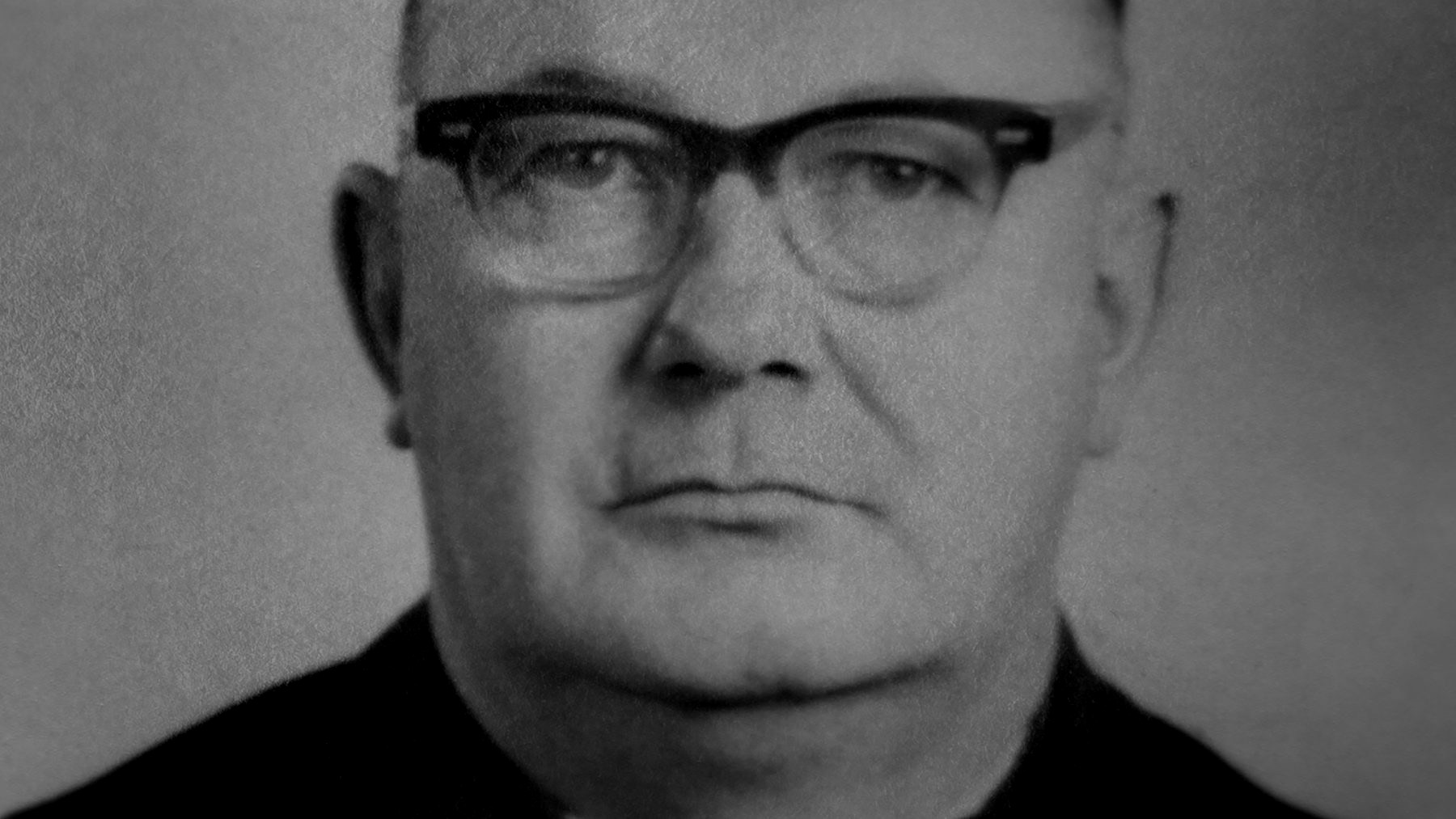
If the name Father Camille Léger sounds familiar, it is because his crimes eventually became impossible to ignore – not because the church intervened, but because enough survivors finally broke through the wall of silence that had protected him for decades.
CBC, NBC, Global News, and the National Post all covered his case. Investigations confirmed more than 250 victims. Some researchers believe the true number is higher. His crimes spanned from 1957 to 1980 – twenty-three years of documented abuse across multiple parishes, with the full knowledge of the Diocese.
He was not removed. He was transferred.
This is the detail the court must not allow to pass without examination: the Roman Catholic Diocese of Moncton was aware of Father Léger's conduct before my family ever arrived in Cap Pelé. In another parish less than fifteen kilometres away, he had already done the same. Their response was not to defrock him, not to report him to law enforcement, not to warn the communities he was being sent to serve.
Their response was to move him.
A predator with institutional protection is not merely a dangerous individual. He is a weapon the institution has chosen to redeploy.
Every Sunday, the people of Cap Pelé watched me sit beside Father Léger at the altar. I was small for my age – eleven, twelve years old, nicknamed Ti-pint and Ti-boy. They saw me. Some of them knew, or knew enough.
They said nothing.
The sociology of institutional deference is well documented. In closed communities organized around a central authority figure – religious, political, or otherwise – the threshold for challenging that figure is artificially elevated. The cost of speaking is made to feel catastrophic: social exclusion, spiritual condemnation, the destruction of relationships built over generations. The cost of silence is distributed across the community invisibly, borne entirely by the victim.
In Cap Pelé, that cost was borne by me. And by the more than 250 others who passed through Father Léger's hands while the village kept its silence.
This is not a community failing to see evil. This is a community choosing its own comfort over the safety of its children. That choice has a name. It is called complicity.
When my mother finally learned what had been done to me, her grief lasted approximately as long as it took to convert into fury. She was ready to kill a priest. Instead, she tried to do something harder – she tried to pursue justice inside a system that had already decided it would not provide any.
She went to the townspeople of Cap Pelé. She was told: you can't go against the church.
She went to the RCMP. Catholic officers stationed locally advised her that pursuing charges would cause embarrassment. They did not tell her this reluctantly. They told her this as guidance – as though protecting the church's reputation from embarrassment was a legitimate law enforcement priority.
She was not given a path to justice. She was given a wall.
Within months, the accumulated weight of what had been done to her son, combined with the complete failure of every system she appealed to, broke her. She suffered a nervous breakdown and was hospitalized for a month.
The church did not only destroy something in me. Through institutional protection and community silence, it destroyed something in my mother as well. Her breakdown was not a personal failing. It was the predictable result of a woman fighting alone against a coordinated system designed to absorb and neutralize exactly the kind of challenge she was making.
She was not weak. She was outnumbered.
In 2012, the Roman Catholic Church contacted me as part of a conciliation process. What that process revealed was not contrition. It was confirmation.
The documentation made clear that the Diocese had long been aware of Father Léger's conduct. The transfer to Cap Pelé was not a failure of institutional oversight. It was institutional oversight – a deliberate calculation that moving him was preferable to exposing him.
This is not conjecture. This is what the conciliation process itself surfaced.
The church did not come to me in 2012 because it had discovered new information. It came because enough survivors had spoken that the legal and reputational exposure had become impossible to manage silently. The conciliation was not an act of conscience. It was crisis management.
I want the jury to hold that distinction clearly: there is a difference between an institution that did wrong and sought to make it right, and an institution that did wrong, concealed it for decades, and eventually offered a settlement when concealment became untenable.
The Roman Catholic Diocese of Moncton is the second kind of institution.
The defence will make several arguments. I will address them directly.
"Father Léger acted alone. The church cannot be held responsible for the independent crimes of one priest."
The evidence does not support this. The Diocese knew of his conduct before his placement in Cap Pelé. They transferred him rather than removing him. They concealed his record from the communities he was sent to serve. The crime was Léger's. The conditions that allowed it to continue for twenty-three years across multiple parishes were the Diocese's.
"The RCMP's handling was a product of its time. Different standards applied."
The prohibition against sexually abusing children is not a modern innovation. It was law in 1977. Catholic officers advising a mother not to report a child predator because it would cause embarrassment to the church is not a cultural artifact. It is a failure of duty with a name: obstruction.
"The community members who stayed silent were themselves afraid. They should not be held to the same standard as the institutional actors."
Fear is real. Social pressure is real. But the children of Cap Pelé were also real, and they were also afraid – of a man the community chose to protect. When the cost of speaking falls entirely on the victim and the benefit of silence accrues entirely to the institution and community, that is not an unfortunate imbalance. That is a system working exactly as designed.
Members of the jury, I was eleven years old. I had already survived violence at home that most adults will never encounter. I was placed, by a desperate and loving mother, into the care of a man the entire Diocese already knew was dangerous.
What followed was not bad luck. It was not the isolated crime of one aberrant individual. It was the harvest of a system that had decided, at every level, that its own survival mattered more than my safety.
Father Léger abused me. The Diocese enabled him. The RCMP protected the institution over the child. The community chose silence over truth. And a mother who fought for justice was broken by the weight of fighting alone.
The Bible that church carried into that sanctuary every Sunday contains these words, in Matthew 18:6:
"If anyone causes one of these little ones to stumble, it would be better for them to have a millstone hung around their neck and to be drowned in the depths of the sea."
By that standard – their own standard – every defendant in this case stands condemned.
Father Camille Léger: Guilty of sexual, physical, and psychological abuse of a child over a period exceeding two years.
The Roman Catholic Diocese of Moncton: Guilty of prior knowledge, deliberate concealment, and the transfer of a known predator into communities of unsuspecting families.
The RCMP: Guilty of institutional deference that placed the reputation of a church above the legal protection of a child and the legitimate pursuit of justice by his mother.
The Parishioners of Sainte-Thérèse-d'Avila: Guilty of collective silence in the presence of knowledge – a silence that was not passive, but chosen, and whose cost was paid entirely by the children it abandoned.
If your faith asks you to protect an institution above a child, your faith has already failed its most basic test.
In Cap Pelé, truth was not the first casualty. The children were. Truth was just the one nobody noticed missing until decades later.
This court noticed.